


Posted on 14 July, 2026
10 Leadership Coaching Techniques Every Executive Coach Should Know
Share On:



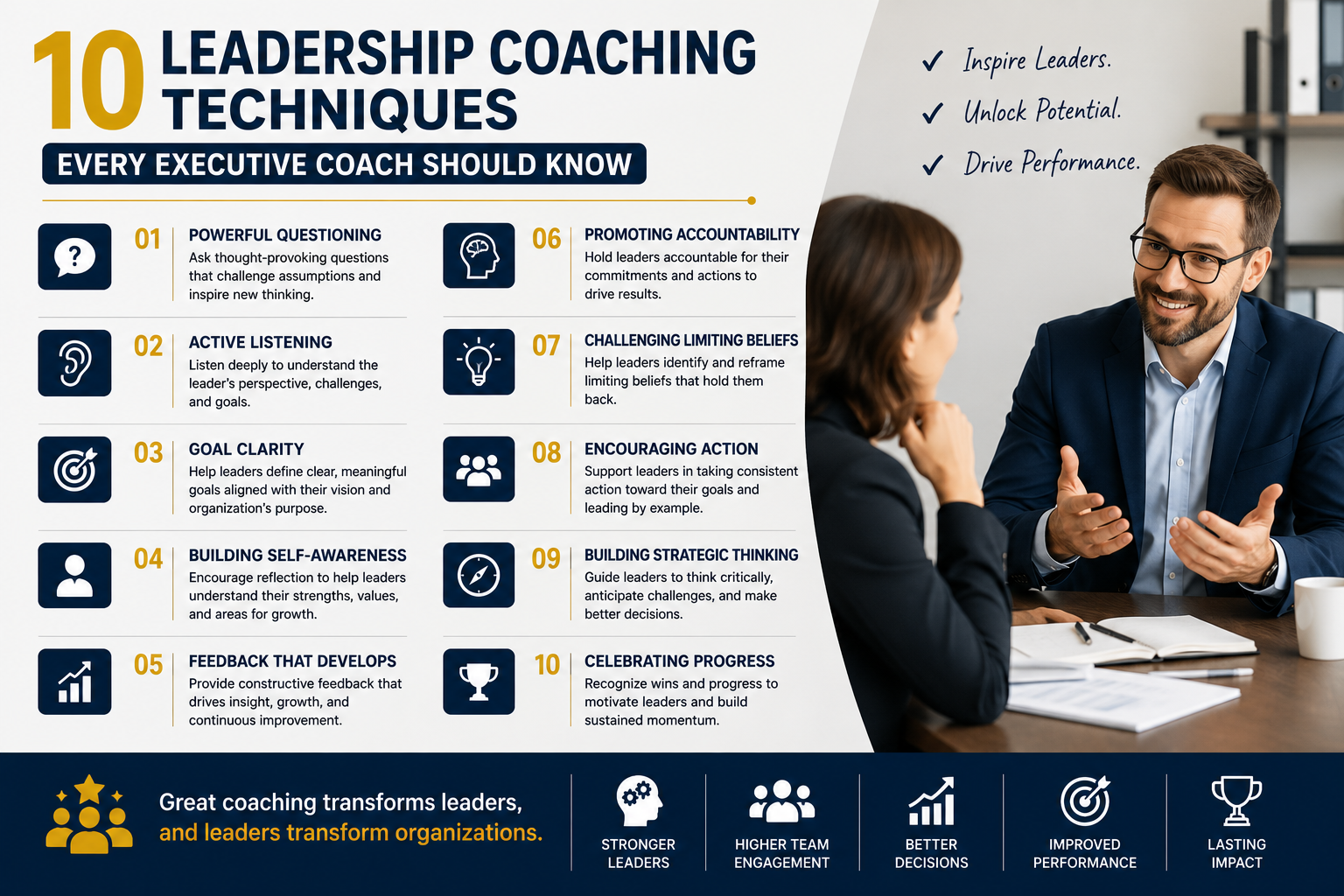
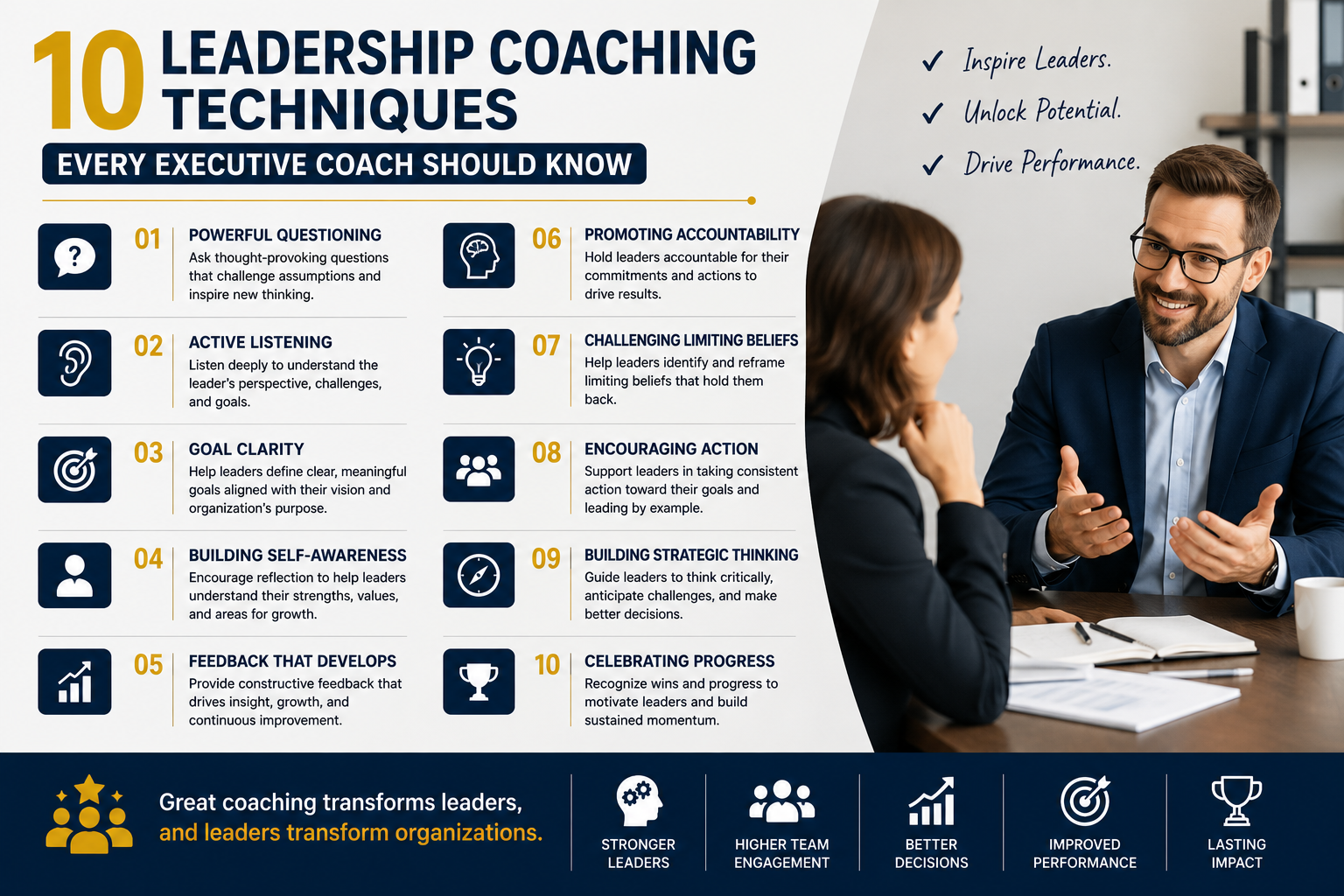
Leadership coaching facilitates improvement in people's abilities to lead by enhancing their communication abilities and their decision-making skills. An executive coach helps the employees learn Leadership Coaching Techniques that play a role in leading clients through the highs and lows they encounter while managing other people. Nevertheless, effective coaching requires something more than simply experience, it involves the use of the right methods.
In this blog, we will talk about 10 Leadership Coaching Techniques Every Executive Coach Should Know
10 Leadership Coaching Techniques for Every Executive Coach
1. Active Listening
Active listening is one of the most effective coaching techniques. Instead of rushing to provide solutions to a person's problems, the coach should take a careful look at the client's ideas, concerns, and objectives.
This helps establish a trust basis and provides the coach with insight into the actual sources of the problems at work. Listening properly also stimulates leaders to think about their own solutions.
2. Making Use of the Right Questions
An executive coach should not just provide answers; instead, it is more beneficial to ask open-ended questions so that the client thinks.
For example, the coach can ask:
- What is standing in the way of your achieving your goal?
- How would you have done it otherwise?
- What do you wish to achieve as the result of your actions?
Asking the right questions will get you more clarity and will be easily able to make the right decision for the client.
3. Understanding the psychology behind setting the smart goals
We have to make sure that the coaching is easily accessible and used by the employees to get the best benefit. SMART here stands for
- Specific goal to be achieved
- Measurable tells us about the timeline and the realistic nature of the goals
- Achievable tells us that everything is attainable with a proper plan.
- Relevant tells us about the relevancy of the goal.
- Time-oriented tells us about the timeline needed to attain the goal.
For example, instead of saying, “Be a better leader”, it can be translated into “increase communication within the team during weekly individual meetings for three months”.
4. Giving genuine and realistic feedback to the employee
Honesty is the best thing one can do for their peers and customers. Make sure to deliver the true assessment to get the best out of it.
Good coaches point out the person’s strong points and indicate the areas they need to work on. Constructive feedback should refer to behavior instead of personality and show the way for improvement.
Clients and customers will accept positive feedback and will take it as an improvement towards their future.
5. Developing self-awareness
A lack of self-awareness leads to many leadership issues. A good coach helps the leaders know their strong points, weaknesses and emotions.
Self-awareness can be achieved by various reflection methods, checking personality types and holding constant conversations at the workplace.
Self-aware leaders make the right decisions, communicate effectively and lead their teams well.
6. Applying Emotional Intelligence Coaching
Emotional intelligence (EQ) plays an important role in effective leadership. Emotional intelligence lets people understand their emotions and helps them manage these easily without any issues. A high EQ person is also able to develop a relationship easily with their peers and brings out the best in everyone.
Executive coaches are expected to provide support in the following areas:
- The coaches help the employees understand about there emotional triggers
- Helps them understand the tough situations and lets them handle them with care
- Make them empathetic about their peers
- This helps them to develop the best relations with employees in their working surroundings.
The effectiveness of leadership and employee engagement is often dependent on one’s level of emotional intelligence.
7. Role-playing Real Situations
Role-playing helps managers cultivate the skills needed for difficult conversations in a safe environment before doing so in the workplace.
For instance, clients can practice their skills to:
- Deliver performance feedback
- Resolve workplace disagreements
- Lead team meetings
- Announce changes in the organization
Such a technique enhances the confidence of the leaders.
8. Developing Accountability
Coaching is efficient when clients are good at taking responsibility for their actions.
Executive coaches need to regularly check the progress, discuss the completed tasks, and pinpoint obstacles that prevented the clients from succeeding. Accountability is a good way of ensuring that clients are committed and improving continuously.
Simple follow-up questions such as “What have you achieved since our last meeting?” may help to maintain efforts.
9. Fostering a Growth Mindset
Accomplished leaders are well aware that they can develop their skills by means of education and learning from experience. Having a growth mindset for yourself and for your organization is a crucial thing that is important.
The clients must learn these basics to excel in life.
- The learners should understand the mistakes and make sure they learn from them.
- The welcoming feedback is very crucial for the employees
- Always being open and reliable to new ideas.
- The learning curve is also very important for the employees.
A growth mindset allows leaders to respond to different changes in the business setup around them.
10. Setting Up Action Steps
Every coaching session must end with clearly formulated steps to be taken in the future. Rather than just having an abstract notion of what to do, clients are recommended to make a concise action plan consisting of:
- Set tasks
- Set deadlines
- Define results
- Set the dates of progress checkpoints
A well-formulated action plan allows one to turn conversation into a measurable achievement.
Why These Coaching Approaches Matter
Business coaching is about helping and guiding employees and other leaders to become the best version of themselves and helping their peers to excel. Combining these approaches enables executive coaches to generate meaningful discussions aimed at establishing long-lasting progress.
Furthermore, effective coaching can positively affect:
- Leadership confidence
- Communication within the team
- Engagement of employees
- Decision-making
- Problem-solving
- Relationships in the workplace
If coaching professionals use the techniques described above, they can assist managers at different levels of their development.
Blockquote
Great leadership isn't about having all the answers—it's about asking the right questions, listening with purpose, and inspiring others to achieve their best.
Conclusion
People in top positions and other leaders have some specific skills that make them different from others. The skills make sure that they have become active listeners and empathetic leaders who understand the situations and do not react. This makes them worthy of making good decisions for the organization and for the employees.
Heart Acuity is a top provider of leadership coaching courses for industry leaders and mentors. Feel free to learn more in detail about the courses provided by Heart Acuity.
Featured Blogs

Contact Us
FREQUENTLY ASKED QUESTIONS
Leadership is not only about being good at technical skills. A good leader understands the holistic betterment of their employees. This helps them to gain more freedom easily.
Active listing and proper understanding of the client's issues are very crucial in deciding the quality of life in the working area.
Emotional intelligence is very crucial to have the best personal and professional results in life. This helps people to understand and be empathetic towards themselves and their peers.
The coaching time can vary according to the course you have chosen. Many different types of courses are being offered under the coaching services. It can vary from 2-3 months to 10-12 months.
Success in leadership coaching may be understood as improvement in leadership skills and team performance after achieving coaching objectives.
Yes, effective leadership makes it easier to maintain a positive working atmosphere that promotes employee satisfaction and retention.
Recent Blogs
Posted on: Jul 14, 2026
Read More
Posted on: Jul 14, 2026
Read More